Document Control Fundamentals

- Description
- Curriculum
- Notice
- Reviews
Document Control Fundamentals
Document Control Fundamentals is a practical professional course designed to help learners manage controlled information accurately, securely, and confidently. The course explains how document control supports engineering, procurement, construction, operations, quality, safety, contracts, audits, records, and project closeout.
Learners will study document lifecycle management, document numbering, metadata, registers, review workflows, transmittals, distribution control, revision control, engineering drawings, vendor documents, records management, EDMS workflows, audit readiness, KPIs, safety-critical documents, and continuous improvement.
Course Outcome
By the end of this course, learners will be able to operate a basic controlled document system, maintain document registers, manage review workflows, issue transmittals, control revisions, protect records, support audits, and prevent common document control risks in real workplace situations.
Key Topics Covered
- Document control purpose, principles, value, and professional control focus
- Controlled versus uncontrolled documents and the risks of wrong revision use
- Document lifecycle from creation, review, approval, issue, use, revision, supersession, archive, and disposal
- Document controller role, originators, reviewers, approvers, clients, contractors, vendors, RACI, and escalation
- Document numbering, coding, naming conventions, metadata, title blocks, and document headers
- Document registers, status tracking, action tracking, aging reports, reports, dashboards, and register control mistakes
- Review workflows, approval planning, comment management, approval status codes, bottlenecks, and review control best practices
- Transmittals, distribution lists, purpose of issue, external communication control, confidentiality, and distribution risks
- Revision control, revision coding, revision history, superseded documents, change reasons, and approval evidence
- Engineering documents, drawings, vendor documents, comment sheets, review matrices, redlines, and as-built documents
- Records management, retention rules, archiving principles, handover documentation, archive completeness, and disposal control
- EDMS functions, permissions, access control, search, retrieval, digital audit trails, and digital control risks
- Document control in quality systems, audit readiness, common audit findings, KPIs, corrective actions, and compliance practices
- Implementation planning, safety-critical documents, daily document control routines, high-risk mistakes, and continuous improvement
-
1
 Document Control Fundamentals
Document Control Fundamentals
Learn how to manage controlled documents, document lifecycle, revision control, registers, transmittals, EDMS workflows, records, compliance evidence, audits, and project closeout.
-
2
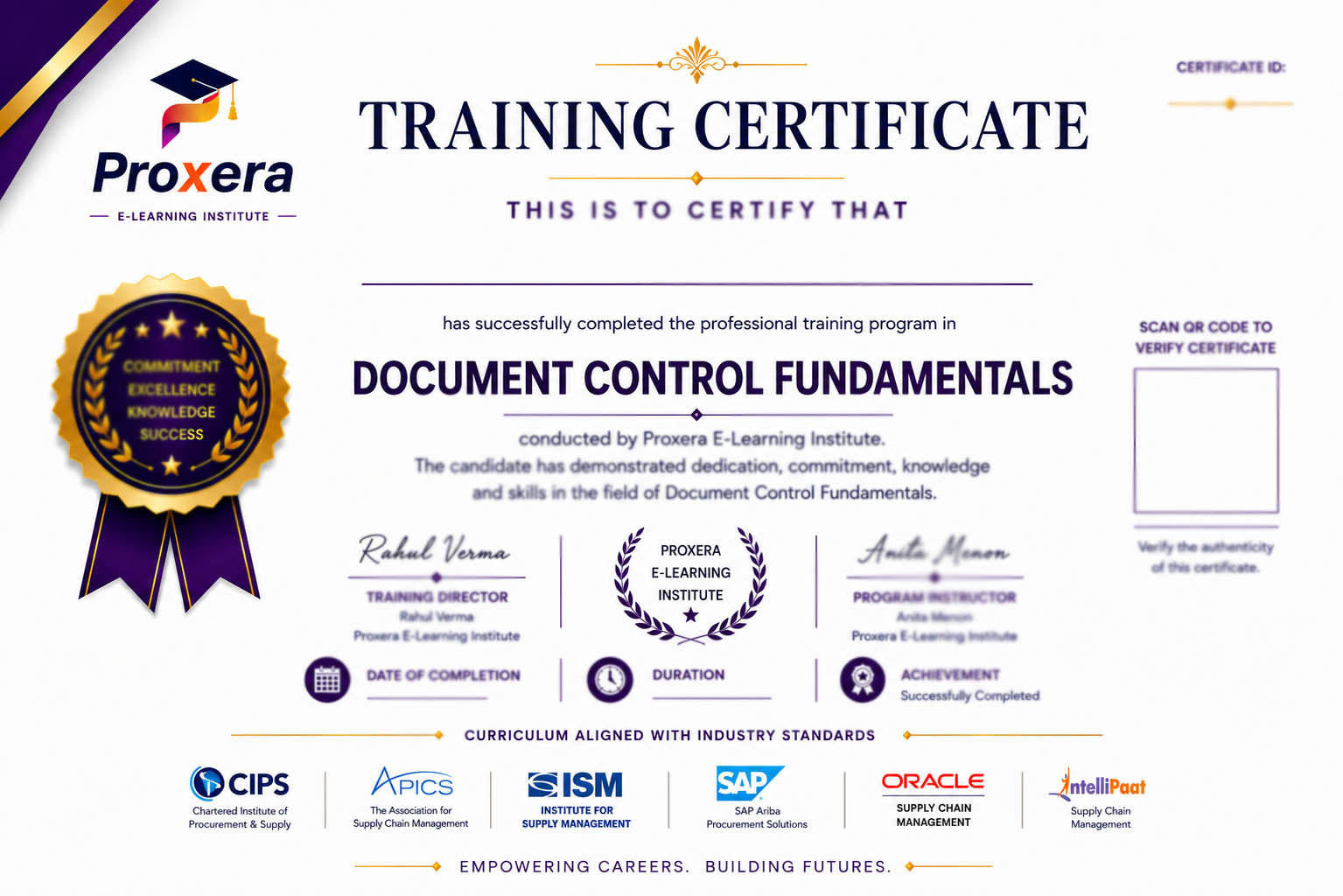
 Document Control FundamentalsAfter successfully answering and completing the quiz questions, the course certificate will be automatically available in the student portal. Students can access their account, open the certificate section, and download or view their certificate after meeting the course completion requirements.
Important Course Notice
Please read this notice carefully before starting the Document Control Fundamentals course.
After purchasing this course, learners will receive access to the available lessons, learning materials, and course content through their student account.
This course is designed for online self-paced learning and professional workplace training. Learners can study anytime and from anywhere using a mobile phone, tablet, laptop, or computer.
Learners are encouraged to complete all lessons carefully to understand document lifecycle, numbering, metadata, registers, workflows, transmittals, revision control, EDMS, records, audits, KPIs, safety-critical documents, and project closeout.
Upon completing the course requirements and assessment, eligible learners may receive a certificate of completion from Proxera E-Learning Institute.
Course Basic Information
Document Control Fundamentals
Professional Training Course
PowerPoint / E-learning Delivery
13 Training Modules
Document Lifecycle, Revision Control, EDMS, Records & Closeout
Identity, Status, Review, Distribution & Evidence
Online Self-Paced Learning
Certificate of Completion
Course Requirements
- No previous document control experience is required.
- Basic understanding of office documents, project files, emails, drawings, reports, or records is helpful.
- Learners should be willing to apply structured filing, numbering, tracking, and workflow discipline to real documents.
- Basic awareness of project communication, approvals, registers, and document revisions is useful but not mandatory.
- Learners should have access to a mobile phone, tablet, laptop, or computer.
- Internet access is required to complete the online course content.
- Learners are encouraged to complete all modules carefully before taking the assessment.
- Basic English reading ability is recommended because the course content is delivered in English.
Intended Audience
Learners who need a structured foundation in document lifecycle, registers, review workflows, transmittals, revision control, EDMS, and records management.
Professionals handling project files, formal correspondence, submissions, reports, approvals, action tracking, and controlled communication.
Engineering and technical staff who create, review, approve, revise, and use drawings, specifications, calculations, datasheets, redlines, and as-built documents.
Teams responsible for procedures, inspection records, certificates, audit evidence, safety-critical documents, compliance files, and controlled records.
Professionals managing vendor documents, formal submissions, technical submittals, contractual correspondence, certificates, and supplier document requirements.
Learners preparing to work in EPC, construction, oil and gas, manufacturing, operations, maintenance, corporate compliance, or project closeout roles.