Cloud Computing Fundamentals
Cloud Computing Fundamentals
This course introduces the core principles, technologies, service models, deployment models, security practices, operational methods, and cost management concepts used in modern cloud environments. Learners will understand how cloud computing delivers scalable IT resources over the internet and how organizations use cloud platforms to improve agility, resilience, security, and operational efficiency.
Course Type
Professional Training Course
Course Format
Professional Edition / 100+ Slides
Focus Area
Cloud Services, Infrastructure, Security, Operations & Cost Optimization
What You Will Learn
- Define cloud computing and explain its core characteristics, benefits, and business value.
- Understand the NIST cloud computing characteristics including on-demand self-service, broad network access, resource pooling, rapid elasticity, and measured service.
- Compare cloud computing with traditional on-premises IT in terms of cost, scalability, maintenance, deployment speed, disaster recovery, and global reach.
- Explain the three primary cloud service models: Infrastructure as a Service, Platform as a Service, and Software as a Service.
- Understand the shared responsibility model and how responsibilities differ across IaaS, PaaS, and SaaS.
- Identify public, private, hybrid, community, and multi-cloud deployment models and select the right model for different business scenarios.
- Describe cloud infrastructure components including virtual machines, containers, Kubernetes, serverless computing, regions, availability zones, auto scaling, and load balancing.
- Understand cloud storage and database services including object storage, block storage, file storage, relational databases, NoSQL, data lakes, and data warehouses.
- Apply cloud networking and security concepts including VPCs, subnets, VPNs, DNS, CDNs, IAM, Zero Trust, encryption, compliance, and security monitoring.
- Understand cloud operations including Infrastructure as Code, CI/CD, monitoring, observability, incident response, DevOps, SRE, migration strategies, and disaster recovery.
- Analyze cloud cost models, cost drivers, FinOps practices, right-sizing, reserved pricing, spot instances, lifecycle policies, budgets, tagging, and cost governance.
- Recognize cloud architecture best practices, common mistakes, cloud safety notes, certification pathways, and professional readiness requirements.
Course Modules
Introduction to Cloud Computing
Cloud Service Models
Cloud Deployment Models
Core Cloud Infrastructure
Cloud Storage and Databases
Cloud Networking and Security
Cloud Management and Operations
Cloud Cost Management and Optimization
Best Practices and Common Mistakes
Assessment and Course Summary
-
1
 Cloud Computing Fundamentals
Cloud Computing Fundamentals
Learn the essential foundations of cloud computing, including IaaS, PaaS, SaaS, public, private, hybrid and multi-cloud models, cloud infrastructure, storage, databases, networking, security, operations, cost optimization, and cloud best practices.
-
2
 Cloud Computing Fundamentals Quiz
Important Course Notice
Please read this notice carefully before starting the Cloud Computing Fundamentals course.
After purchasing this course, learners will receive access to the available lessons, learning materials, and course content through their student account.
This course is designed for online self-paced learning and professional IT training. Learners can study anytime and from anywhere using a mobile phone, tablet, laptop, or computer.
Learners are encouraged to complete all lessons carefully to understand cloud computing concepts, service models, deployment models, cloud infrastructure, storage, databases, networking, security, operations, cost optimization, best practices, and common cloud mistakes.
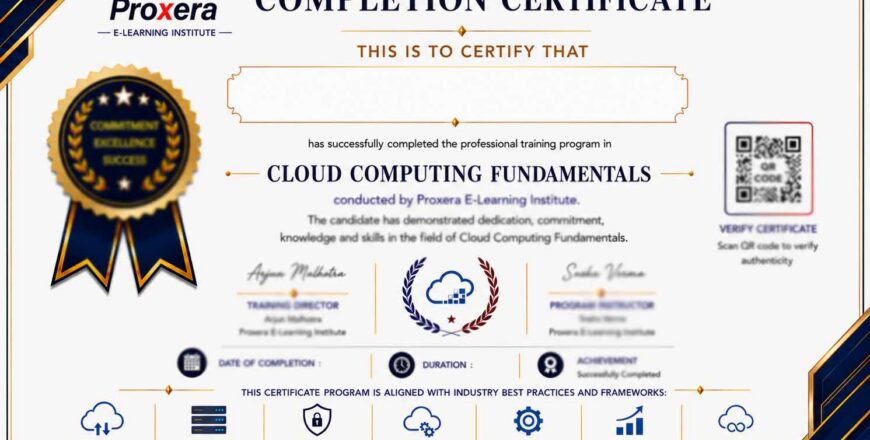
Upon completing the course requirements and assessment, eligible learners may receive a certificate of completion from Proxera E-Learning Institute.
Course Basic Information
Cloud Computing Fundamentals
Professional Training Course
Professional Edition / 100+ Slides
10 Training Modules
104 Professional Slides
Entry to Intermediate Professional Level
Cloud Infrastructure, Security, Operations & Cost Optimization
Certificate of Completion
Course Requirements
- No advanced cloud experience is required.
- Basic computer literacy and general understanding of IT systems are recommended.
- Basic awareness of servers, networks, storage, software, or business applications is helpful but not mandatory.
- Learners should be willing to understand cloud concepts from both technical and business perspectives.
- Learners should have access to a mobile phone, tablet, laptop, or computer.
- Internet access is required to complete the online course content.
- Learners are encouraged to complete all modules carefully before taking the assessment.
- Basic English reading ability is recommended because the course content is delivered in English.
Intended Audience
Learners who want a structured introduction to cloud computing concepts, service models, deployment models, infrastructure, security, and operations.
IT staff who need to understand cloud environments, virtual machines, containers, networking, storage, databases, monitoring, automation, and cost control.
Professionals transitioning from traditional on-premises infrastructure into cloud-based systems, managed services, automation, and cloud operations.
Developers who need foundational understanding of PaaS, serverless, containers, Kubernetes, CI/CD, cloud deployment, and managed databases.
Managers who need to understand cloud business drivers, cost models, vendor selection, deployment models, security responsibilities, and governance decisions.
Students and professionals preparing for foundational cloud certifications such as AWS Cloud Practitioner, Microsoft Azure Fundamentals, Google Cloud Digital Leader, or similar pathways.